Understanding Carbon Offsetting
A carbon credit represents one tonne of carbon dioxide equivalent that has either been prevented from entering the atmosphere or removed from it, quantified against a counterfactual baseline and issued by a registry under a recognised methodology. When a company retires that credit against its own emissions, the claim is that its net position has improved by one tonne.
Credits originate from two broad families of activity. Avoidance and reduction projects prevent emissions that would otherwise have occurred — renewable energy displacing fossil generation, methane capture at landfill sites, improved cookstoves, avoided deforestation. Removal projects take carbon out of the atmosphere and store it, through afforestation and reforestation, soil carbon, biochar, enhanced weathering, or engineered approaches such as direct air capture with geological storage. The two differ fundamentally in permanence and in cost, and they are not interchangeable.
Used well, credits channel finance to climate projects that would not otherwise be funded and put a price on emissions inside a company's own decision-making. The problem is not the instrument. The problem is what happens when it is used as the primary strategy rather than the last step.
The Limitations of a Pure Offsetting Strategy
An offsetting-led approach can look complete on paper while leaving the underlying business exactly as carbon-intensive as it was. Four weaknesses recur, and each has become more consequential as scrutiny has increased.
- Lack of Structural Change — Buying credits changes nothing about energy intensity, process efficiency, fleet composition or supply chain design, so the company's exposure to carbon pricing and energy volatility is unchanged — and the cost of the credits recurs every year.
- Regulatory Scrutiny — Disclosure regimes increasingly require gross emissions to be reported separately from any neutralization, and net-zero frameworks require deep absolute reductions before offsets count toward a claim at all.
- Greenwashing Risk — Unqualified neutrality claims backed mainly by purchased credits have drawn consumer protection action, litigation and investor challenge, turning a marketing decision into a legal and commercial exposure.
- Quality Variability — Project quality ranges from rigorous to indefensible, with recurring concerns about inflated baselines, weak additionality, reversal of stored carbon and double counting — meaning a retired credit does not automatically equal a real tonne.
The Smart Approach: A Hierarchy of Climate Action
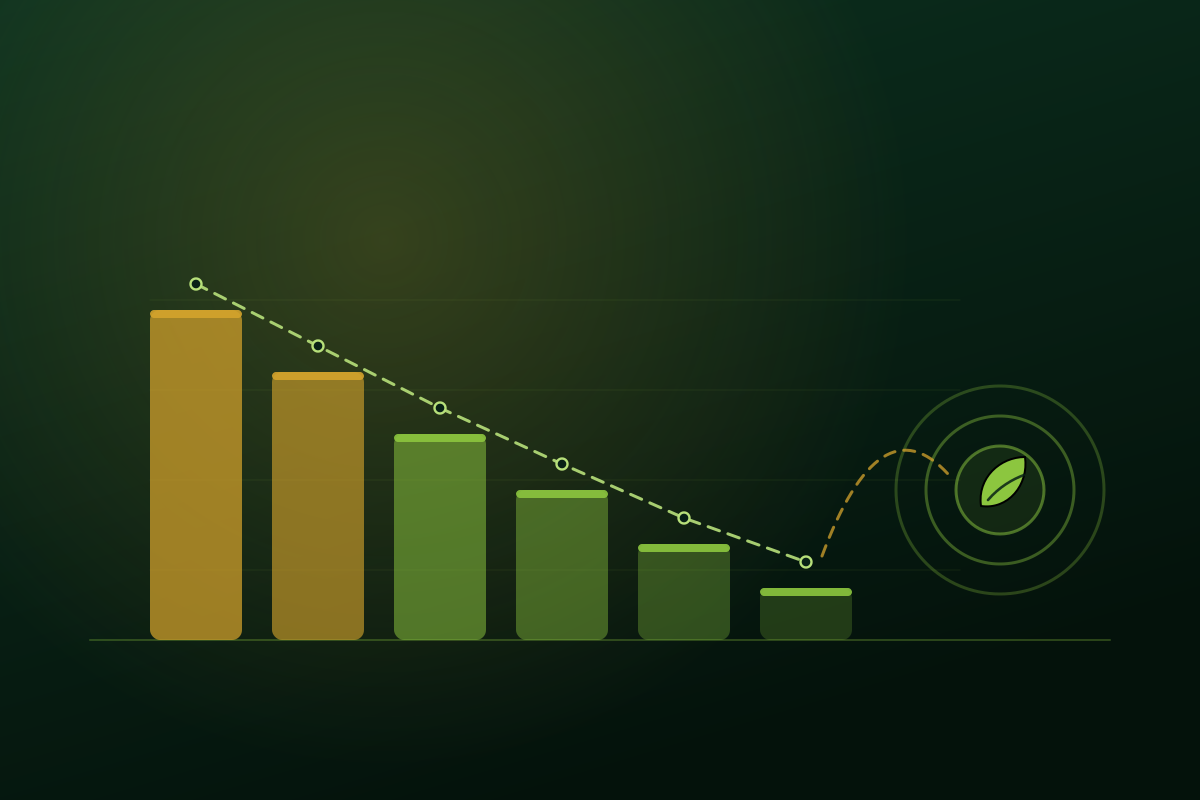
The alternative is not to abandon credits but to place them last in a sequence that puts abatement first. This hierarchy is what the major frameworks now expect, and it is also the version that produces financial returns alongside emissions reductions.
- Measure — Build a complete Scope 1, 2 and 3 inventory to GHG Protocol standards, with data quality good enough to survive assurance and granular enough to identify where emissions actually sit.
- Reduce — Execute the available abatement in order of cost and speed — efficiency, electrification, renewable procurement, logistics and supplier engagement — against a validated target trajectory.
- Innovate — Address the emissions that current technology cannot eliminate through product redesign, material substitution, process innovation, circular models and collaboration with suppliers and industry peers.
- Neutralize — Apply high-integrity credits only to the residual that remains, weighting durable removals more heavily over time and disclosing the volumes separately from gross emissions.
Net-Zero vs. Carbon Neutral
The two terms are used interchangeably in general conversation and mean quite different things in practice. Carbon neutral describes a balance between emissions and an equivalent quantity of credits, and it can in principle be achieved with very little internal reduction — a company can be carbon neutral this year and no less carbon-intensive than last year.
Net-zero sets a much higher bar. It requires deep absolute decarbonisation across Scope 1, 2 and 3 in line with a 1.5°C trajectory before any residual is addressed, limits that residual to a small share of the baseline footprint, and expects the remainder to be neutralized with permanent removals rather than avoidance credits. It is a statement about the state of the business, not about the size of a purchase.
The practical consequence is that the two claims fail differently. A carbon neutral claim is fragile: it depends on the quality of credits bought each year and on language that regulators are actively testing. A net-zero position is durable, because the emissions are genuinely gone from the operation and cannot be revoked by a registry, a media investigation or a change in guidance. Companies should be explicit about which one they are making and on what basis.
Strategic Benefits of Doing It Properly
Credibility with regulators and investors is the most immediate return. A reduction-led programme with assured data answers CSRD disclosure requirements, CDP questionnaires and investor due diligence from the same evidence base, and it holds up when a third party checks it. An offset-led claim requires defending each year and weakens as standards tighten.
The cost curve is the second. Efficiency and electrification lower operating expenditure permanently, whereas credits are a recurring purchase in a market where high-integrity supply — particularly durable removals — is scarce and prices are widely expected to rise as demand and quality requirements increase. Reducing exposure to the EU ETS and CBAM has direct value for industrial companies, and every tonne removed from the inventory is a tonne no longer needing to be bought.
Supply chain leverage is the least visible and often the largest. Because the majority of most corporate footprints sits in Scope 3, engaging suppliers on primary data and reduction plans improves the accuracy of your own reporting, surfaces cost and resilience issues that would not otherwise have been examined, and positions the company well with customers running the same programme one tier up.
Building Credible Climate Leadership
Credibility comes from precision about what has and has not been achieved. Publish gross emissions by scope, the reductions delivered against the baseline, the measures that produced them, and the volume and type of credits retired — as separate figures, not as a single net number. Where a target has been missed or a milestone delayed, say so and explain what changed. Sophisticated stakeholders discount unqualified perfection heavily.
Be equally clear about methodology. State the boundary, the baseline year, any recalculation and why it was made, the emission factors used, and whether the figures are assured and to what level. Transparency of this kind costs nothing to a company that has done the work and is impossible to fake for one that has not.
Climate leadership, in the end, is not a communications position. It is the accumulated result of measuring honestly, reducing where it is difficult as well as where it is easy, innovating on the emissions nobody yet knows how to remove, and neutralizing only what genuinely remains. Companies that build in that order will find their claims outlast the scrutiny that catches the ones that started at the end.
Offsets are the last step
Credits belong to the residual emissions left after real decarbonisation; used as a substitute for abatement, they buy a claim rather than a result.